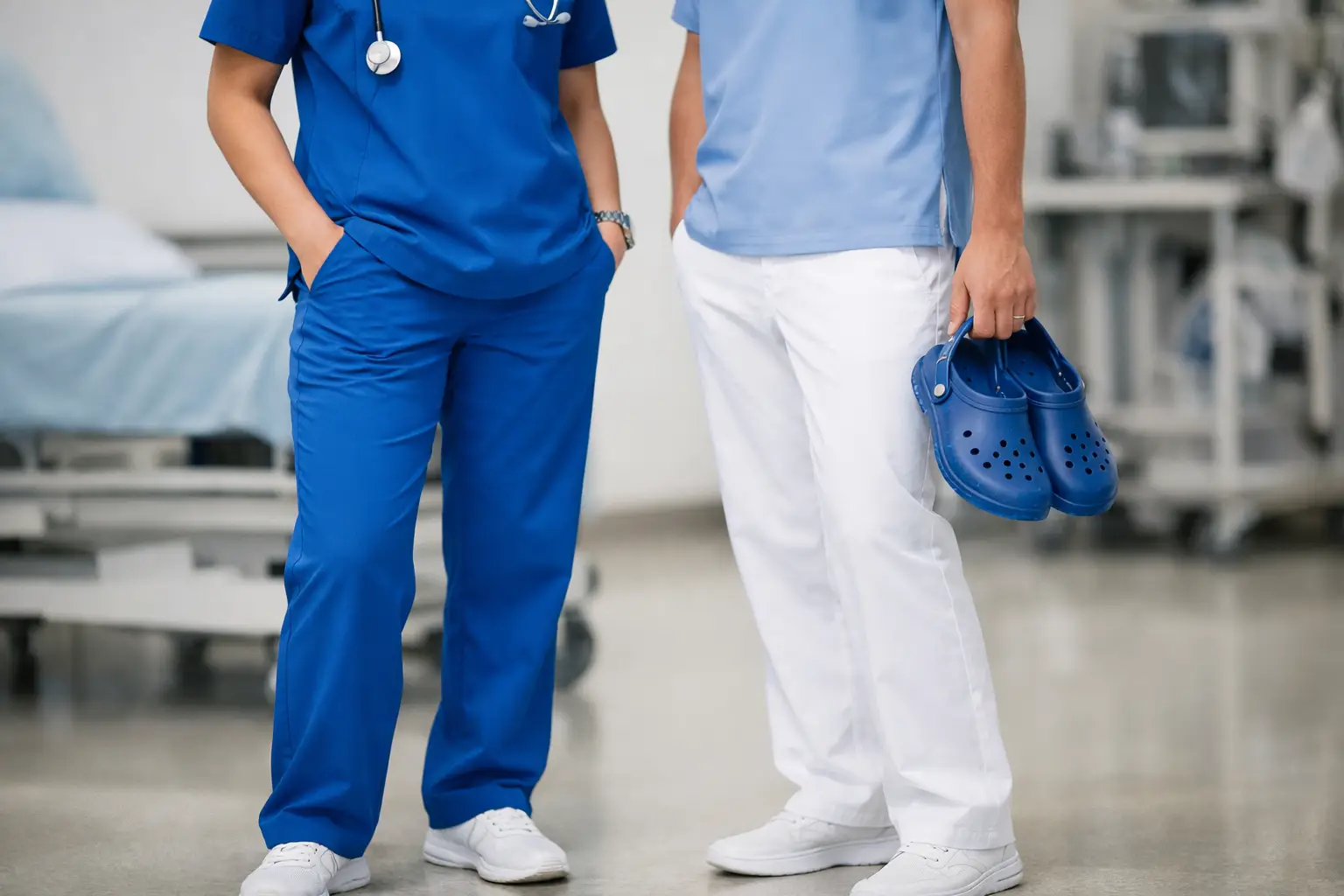
One incorrectly sewn elastic waistband is enough to make you think about clothes more often than about work after a 12-hour shift. Therefore, medical trousers are not an addition to the set, but one of the most important elements of the staff's daily clothing. They should fit well, not restrict movement, withstand frequent washing and still look professional after many shifts.
In practice, a good choice starts with a simple question: what does your working day look like? A nurse who is constantly on the move will need different features, a doctor who sees patients in the office, and still different features will be needed by laboratory staff or a team that assembles clothes for the entire facility. That's why it's worth looking not only at the color or price, but above all at the cut, fabric, waist, pockets and fit.
Medical trousers for everyday work
In medical clothing comfort does not mean a loose, casual cut. It is a cut that allows freedom of movement when bending, sitting, moving quickly around the ward or working at the patient's bed. Pants should work with the wearer, not resist every movement.
This is why the construction of the leg and waist is so important. A cut that is too narrow may look aesthetically pleasing at the beginning of the day, but after a few hours it can be simply tiring. On the other hand, trousers that are too wide give you freedom, but sometimes they lose their professional look and are worse when moving. Balanced models work best - fitted, but not tight.
Well-chosen medical trousers also support your image. In a healthcare facility, a neat, consistent appearance is important for patients and the entire team. Work clothes don't have to be shapeless to be practical. Modern cuts allow you to combine comfort with aesthetics, which is especially appreciated by people who work many hours in direct contact with the patient.
What to pay attention to when choosing
The most problems in everyday use do not result from the appearance of the trousers themselves, but from the omission of several basic parameters. The first is the material. The fabric should withstand intensive use and frequent washing, while ensuring comfort of wearing all day long. If the material is too stiff, the pants start to get in the way more quickly. If too thin, they may lose their shape and be see-through.
The second issue is flexibility. A small amount of fibers responsible for stretchability often actually improves comfort. This is especially important where the working day means constant movement, changing positions and repeated bending. However, not every person needs the same level of flexibility. In a consultation room, priorities may be different than on intensive duty.
The third element is the finishing of the belt. The elastic belt allows for a quick and comfortable fit, which is why it is often chosen by people who value comfort and simplicity. Models with additional ties help to better stabilize the pants at the waist. In turn, more structured styles with a smooth front may look better in places where a very aesthetic, formal presentation is important.
It is also not worth underestimating your pockets. Their number and arrangement affect everyday comfort more than we usually assume when purchasing. For one person, two side pockets are enough, for another person you will need an additional cargo pocket or space for small accessories. If you constantly carry a phone, pen, ID badge or small tools with you at work, the arrangement of pockets is no longer a detail.
Cut and type of duties
The typeface should correspond to real tasks. For shift work, high mobility and frequent movement, looser designs and elastic waistbands work well. They provide greater tolerance for movement and are usually less noticeable after many hours.
In offices, medical receptions and private facilities, more visually organized cuts are more often chosen. They still have to be comfortable, but more emphasis is placed on aesthetics, leg line and overall appearance. It's not a matter of a better or worse choice - just a different work environment imposes different requirements.
Leg length and width
This is one of the most common points that determines satisfaction with the purchase. A pant leg that is too long can interfere with movement and look sloppy. Too short often disturbs the proportions of the figure and reduces comfort. The width of the leg also matters - a narrower one gives a more modern look, but requires a well-selected size and appropriate elasticity of the material.
If you are buying trousers for intense work, it is wise to choose models that are not extreme in any direction. A moderate, functional cut usually lasts longer than a very fashionable cut that looks good mainly in the product photo.
How to choose the size to avoid returns
The most unsuccessful orders come from being accustomed to one size across all brands. In medical clothing it doesn't work that simple. Differences in cut, waist height, waist elasticity and fabric type can change the feeling of fit even with similar dimensions.
The safest place to start is by checking the size chart and comparing it with your own measurements, not with the markings worn "usually". It is worth paying special attention to the circumference of the waist, hips and leg length. If the model has a more fitted cut, it is good to allow room for freedom of movement. If the material contains elastic fibers, the fit can be closer to the body without sacrificing comfort.
When ordering for teams, the selection of sizes requires even greater precision. What matters here is not only the comfort of an individual, but also the efficient organization of the entire purchase. A clear size chart and the ability to sort out the staff's needs in advance make the process much easier, especially when uniformity of clothing throughout the facility is important.
Material and durability after washing
Medical trousers are used intensively, so their quality is visible not after the first wear, but after a dozen or several dozen washes. A good fabric should retain its shape, color and aesthetic appearance despite regular care. This is important both for an individual user and for an institution ordering larger batches of clothing.
In practice, durability means several things at once. The material should not pill quickly, lose shape at the knees or deform at the waist. The seams must withstand daily stress and the color should remain as stable as possible despite frequent washing. When choosing, it is not only about whether the pants are comfortable today, but whether they will be equally useful after a few months of regular work.
There is also a question of compromise here. A very light fabric may feel nice all day long, but it won't always provide the same resistance as a more compact fabric. In turn, thicker material is more durable, although for some people it will be less comfortable in a warmer environment. The best choice depends on working conditions and individual preferences.
Medical trousers for teams and facilities
For purchases B2B the criteria are broader than in the case of a single order. What matters is not only the cut, but also the repeatability of colors, the availability of sizes, the predictability of subsequent orders and the ease of assembling clothes for different positions. It's good if one model works for many people, but in practice it is not always the best solution.
Medical teams often need a consistent look, but staff work in different environments. Therefore, it is wiser to base the order on one color line and a similar quality standard, and at the same time allow for several cuts. This model increases the chance that employees will actually use clothing with comfort, instead of treating it as a chore.
In EXP Odzież Medyczna this way of thinking about purchasing is particularly important - clothing has to look good, but above all, it has to work well in real work. For teams, this means fewer random choices and greater predictability when completing orders.
When is it worth buying more than one pair
If you work shifts, one pair of trousers rarely lasts long. Regular use and frequent washing make clothes rotation simply worthwhile. Two or three pairs provide greater organizational comfort and allow you to keep each of them in good condition longer.
The same applies to branches. A reserve stock of sizes and models helps avoid problems when implementing new employees, seasonal changes in the team or the need to quickly replenish gaps. From the point of view of everyday work organization, it is a practical, not redundant solution.
Well-selected medical pants are supposed to make your day easier, not become another thing to fix on the run. If you focus on the cut, material, size and actual work rhythm when choosing, you will find a model that simply does its job faster - from the first shift to the next wash.