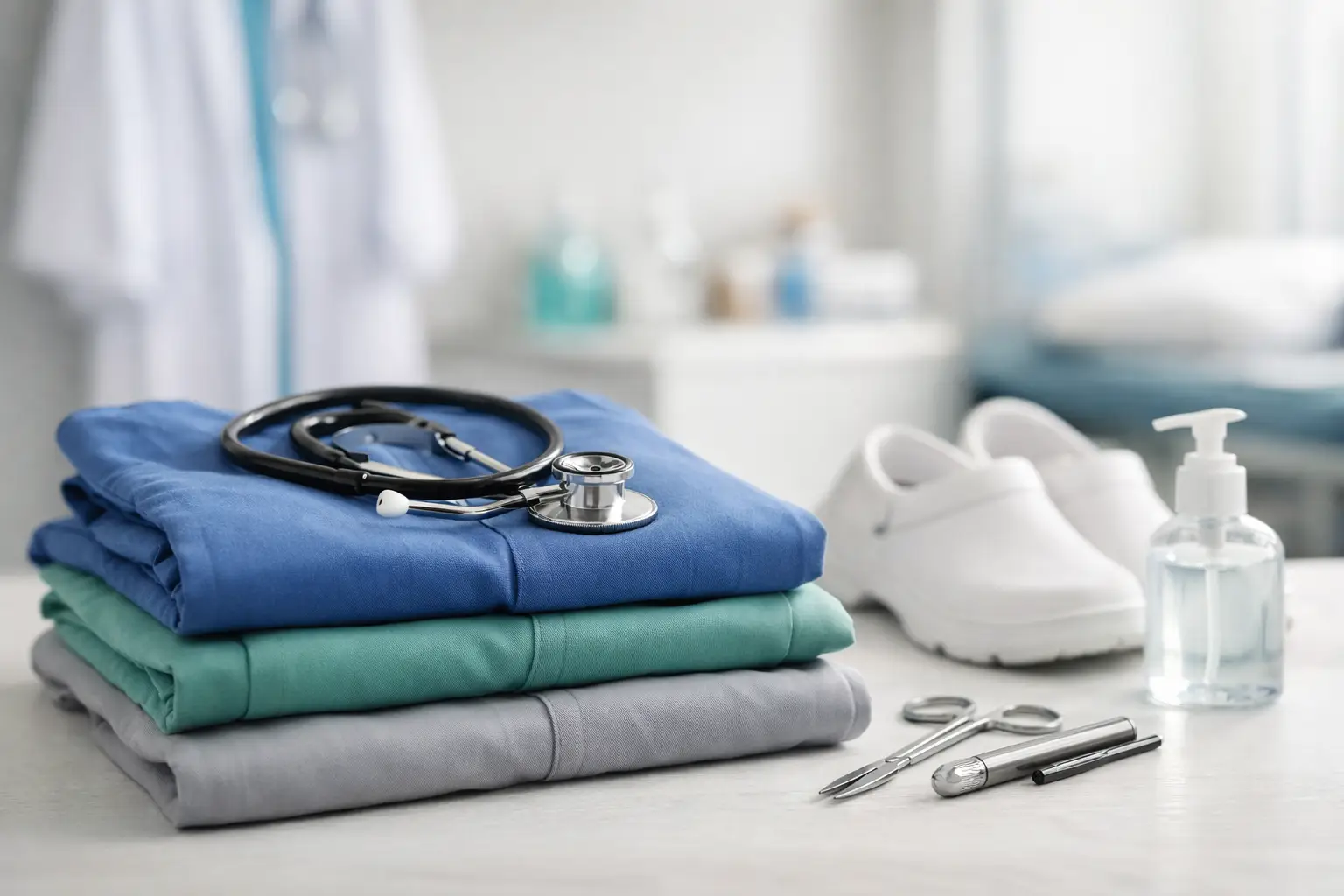
Whether scrubs will work well on duty is often determined not by the cut itself, but by the fabric. Therefore, it is worth starting the guide to medical scrubs materials with a practical question: how should the clothing behave after several hours of work, after many washes and with constant movement? For medical staff, the material is not a detail. This is an element that affects the comfort, appearance and durability of the set.
Medical scrubs material guide - where to start
The most common medical scrubs are made from fiber mixtures, not from a single raw material. This solution makes sense because in everyday work there is a compromise between comfort, resistance and ease of care. Cotton itself may be pleasant to the skin, but it wrinkles faster and dries slower. In turn, polyester improves durability and color stability, but in some configurations it may give a less natural feeling when worn.
Therefore, when choosing, it is worth looking not at the name of the material itself, but at its percentage composition, grammage and method of finishing. Two sets described similarly may behave completely differently after washing or after a whole day of work in the office, ward or laboratory.
Cotton - comfort and breathability
Cotton remains one of the most valued components of medical clothing. It provides softness, good breathability and pleasant contact with the skin. For people working many hours on the move or in warm rooms, this is a big advantage.
It must be honestly said, however, that cotton alone will not always be the best choice for intensive shift work. It may crease more, dry slower and lose its original appearance faster over time than blends with synthetic fibers. If someone is looking for scrubs for very intensive use and frequent washing, breathability alone may not be enough.
Cotton works well where the priority is the natural feel of the material and everyday wearing comfort. In practice, it is often best not to do it alone, but as part of a well-designed mixture.
Polyester - durability and easier care
Polyester is sometimes underestimated, but it plays a very important role in medical clothing. It is responsible for greater resistance to frequent washing, better shape retention and less tendency to crease. For staff who do not want to iron their clothes after each drying, this is a real benefit.
Another great advantage of polyester is maintaining the color. When washed regularly, scrubs should maintain their aesthetic appearance, especially if they are part of a consistent team uniform. This is important both for individual users and for establishments that assemble clothing for a larger number of employees.
The downside may be lower breathability compared to fabrics with a higher cotton content. However, much depends on the quality of the fiber and the entire structure of the material. A well-designed polyester blend can also be comfortable when worn for long periods of time.
Elastane - a small addition, a big difference
If scrubs are to work well with the body, it is worth paying attention to elastane. Even a small percentage of it can improve freedom of movement when bending, raising hands, moving quickly between workstations or working for many hours while standing.
This is especially important for more modern, better-fitting cuts. Without the addition of elastic fiber, the material may look good on a hanger but restrict movement in practice. Elastane improves comfort, but at the same time requires attention to care. Washing or drying temperatures that are too high may weaken its properties over time.
Therefore, when choosing, it is worth thinking not only about the first wearing, but also about how the set will behave after many cycles of use.
The best blends for everyday work
In practice, blends of cotton, polyester and elastane work best. This composition combines several needs at once: wearing comfort, durability and better fit. However, there is no one proportionally perfect solution for everyone.
If softness and breathability are a priority, a material with a higher cotton content will be better. If resistance to intensive washing, color stability and less susceptibility to creases are more important, blends with a higher proportion of polyester gain an advantage. In turn, people who are very active at work will usually appreciate the addition of elastane, even if it is only a few percent.
This is the area where the guide to medical scrubs materials becomes the most practical - it is not about theory, but about adapting the composition to real working conditions.
Material weight - a parameter that often determines
Composition is one thing, but grammage is equally important. Lighter material usually works better in summer, in heated interiors and where maximum breathability is important. A heavier fabric may give a greater sense of solidity, drape better and be less transparent.
Higher grammage does not always mean a better choice. In work that requires pace and constant movement, material that is too heavy may simply be tiring. On the other hand, if it is too thin, it may show signs of use more quickly or look worse after many washes. It is best to look for a balance between lightness and durability.
How to recognize good material for clinical work
A good material for scrubs should retain its shape, color and comfort not only after the first use, but also after a long time. It is worth checking whether the fabric is not too stiff, whether it is transparent and whether it has adequate elasticity when moving.
Utility details are also important. The material should match the cut, pockets and the line of the arms or legs. A fabric that is too soft with large pockets may lose its shape, and a fabric that is too stiff may limit comfort. That's why the composition specification alone does not yet give a full picture of the quality.
It's also good to think about the workplace. Treatment staff may have different needs, office staff may have different needs, and people from laboratories or medical registration may have different needs. The more dynamic the work, the more important is flexibility, resistance and ease of care.
Care of medical scrubs materials
Even good material will lose its properties if it is not cared for in accordance with the recommendations. This is particularly important in medical clothing, because frequent washing is the standard, not the exception. Therefore, when purchasing, it is worth checking the recommended temperature, drying method and possible ironing restrictions.
Polyester blends tend to withstand regular washing better and dry faster. Materials with elastane require more caution at high temperatures. Cotton provides comfort, but may need more attention if we want to maintain an aesthetic appearance.
For teams ordering larger number of sets this is especially important. Predictable care means it's easier to maintain a consistent look for all staff and there's less risk of clothes wearing out quickly.
What to choose - depending on the operating mode
Not every user needs the same thing. If scrubs are worn for many hours without a break, fabrics that are flexible, light and wrinkle-resistant are usually the best. When working at a slower pace, you can better appreciate the naturalness and softness of the material.
When purchasing for branches, there is also the issue of repeatability. The material should not only fit well on one person, but also work well in various sizes and for everyday use by the entire team. In such a case, mixtures with stable parameters often turn out to be a safer choice than fabrics that focus only on one advantage.
The most popular solutions in the EXP Odzież Medyczna offer are those that combine a professional appearance with practical durability. This is a sensible direction, because in workwear it is not only the first impression that counts, but everyday usability.
What to look at before buying
Before choosing a set, it is worth considering four issues: composition, weight, elasticity and care method. Only their combination shows whether a given model will be comfortable all day long and whether it will maintain its good appearance after repeated washing.
If you are hesitating between two materials, ask yourself a simple question: what do you expect more - softness and airiness or easier form and color maintenance? This usually allows you to make the right decision faster than comparing just fabric names.
A well-chosen material does not attract attention during work. It doesn't pull, doesn't overheat, doesn't wrinkle after an hour and doesn't look worn out after several washes. And this is the best place to start when choosing scrubs that simply work well with you.