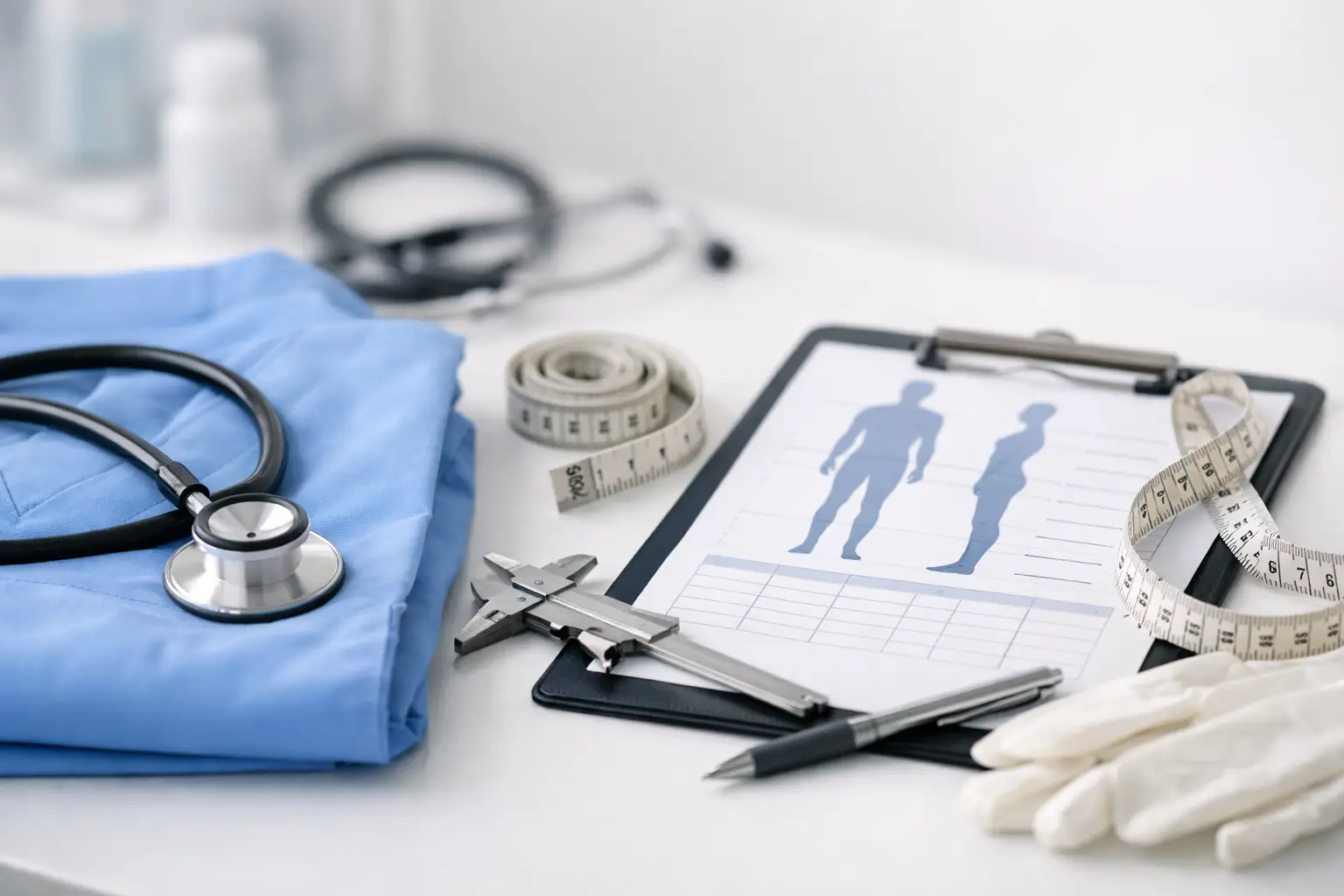
The wrong size of medical clothing can be felt from the first hour of duty. A top that is too tight restricts movement when raising your arms, trousers that are too loose move while walking, and a lab coat that only looks good on a hanger quickly ceases to be practical. Therefore, the guide to the medical size chart is not an addition to the purchase, but a real tool that helps you choose clothing that is comfortable, professional and ready for intensive work.
How to read the medical size chart
The size chart is not for guessing whether I "usually wear M". In medical clothing, specific dimensions are more important than the letter itself. Individual models may differ in cut, leg length, hip width or chest room. The same user can wear a different size of medical top and a different size of pants.
The most important thing is to check your own figure dimensions and compare them with the product table. If the table gives the circumference of the chest, waist and hips, these numbers should determine your choice. The size described as S, M or L is only an abbreviation. In practice, what matters is whether the clothes leave enough room for working, sitting, bending and wearing for many hours.
It is also worth paying attention to whether the table refers to body dimensions or to the dimensions of the clothes themselves. This is an important difference. Body measurements help you choose the size directly to your figure, while the dimensions of the finished clothing show how much space a given model actually provides. When it comes to medical clothes, both information is useful, but you need to know which one you are reading.
Step by Step Medical Size Chart Guide
The best result is obtained by measuring on thin clothing or underwear, in a natural standing position. A tape measure should fit the body, but not press it. If you measure yourself after a whole day of work, when your body is heavy and swollen, the result may be slightly different than in the morning. Therefore, when purchasing a new set, it is worth testing in calm conditions.
Chest or bust
The tape measure is placed at the widest part of the chest. This is the basic dimension for medical tops, lab coats and scrub tops. If this area is too tight, the clothing will start to pull when you move your arms and shoulders. In medical work, this is a problem that can be felt very quickly.
Waist
The waist is measured at its narrowest point. This dimension is especially important for trousers with a belt without full elastic, tied models and more fitted styles. With a high rise and elastic waist, you can allow for a slight difference, but it's still not worth guessing.
Hips
Hips are measured at the widest point. This is crucial for medical pants and longer tops. If the result is between two sizes, the hips often determine the choice of the larger variant, because this area determines the freedom of walking, sitting and bending.
Pant length and height
Not every table shows this parameter equally accurately, but it is worth checking. Pants that are too long will ride up and rub against your shoes, while pants that are too short may look disproportionate and less professional. In facilities where the neat appearance of the entire team is important, this detail makes a difference.
Why the same size doesn't always mean the same
One of the most common mistakes is the assumption that because you wear a specific size in everyday clothes, it will be the same in medical clothing. It doesn't have to be this way. Scrubs are designed with varying degrees of clearance. Some are more classic and casual, others are closer to the silhouette. There are also differences between women's, men's and unisex styles.
The unisex model usually has a simpler design and greater dimensional tolerance, but not everyone suits its arrangement in the hips or shoulders. The women's cut better takes into account the proportions of the bust and waist, while the men's cut more often allows for more room in the shoulders and chest. Therefore, a good choice does not end with checking the table. You still need to assess how a given cut works on the figure.
Material also matters. Fabric with elastane is more forgiving than stiffer material without elasticity. This does not mean that you can choose a size blindly. Rather, with limited dimensions, a flexible model may fit the body better, while a stiffer one will require more space.
What to do if you fall between two sizes
This is a very common situation, especially with medical kits purchased online. If the upper part of the figure indicates one size and the lower part the other, it is best to treat the top and trousers as separate purchasing decisions, if the store allows such an option. This is the easiest way to avoid a compromise that only looks good on the screen.
When the choice concerns one element, it is worth considering where the clothing must work the hardest. When it comes to trousers, the hips and thighs are usually more important than the waist itself, because the waistband is partially adjustable. When it comes to a medical top, the chest and shoulders are sometimes more important than the waist circumference itself. If the model is going to be worn for long shifts, a bit of allowance usually works better than an overly ambitious fit.
There are exceptions, however. An lab coat that is too large may make it difficult to move quickly between consultation rooms, and a top that is too loose may stick out at the pockets and look less neat. So the answer isn't always "choose bigger." Sometimes a size closer to your figure will be better if the material is flexible and the cut allows for freedom of movement.
What to look at beyond the table
A good size chart is the basis, but not the only source of decisions. In practice, it is worth comparing it with the description of the cut. Information about whether the model is regular, slim or relaxed fit helps predict how the clothing will fit once worn. This is especially important when ordering for teams, where consistency and reducing the number of replacements are important.
Data about the waist height, type of belt, number of pockets and the way of finishing the sleeves or legs are also useful. These items do not change the size number, but do affect comfort. Trousers with an elastic waist will behave differently than a model with a more structured waist. A top with more pockets may arrange differently when you put accessories, a phone or a notebook.
In a specialist store such as EXP Odzież Medyczna, the advantage of a well-prepared offer lies in the fact that the user can assess not only the size, but also the practicality of the style. And this is very important in workwear.
Sizing for medical teams
In B2B purchases, the size problem is slightly different than when ordering for one person. What counts here is not only the comfort of individual employees, but also efficient data collection and limiting mistakes. The most common error is collecting only "M please" declarations without reference to the table.
A safer solution is to collect the basic dimensions of the entire team and assign them to a specific model. This is important because the sizes of one manufacturer do not have to match those of another. If the facility wants to maintain a uniform appearance for its staff, it is also worth checking whether the selected style fits well on different body types. Sometimes a more universal cut gives a better organizational effect than a very fitted premium model.
For larger orders, it is good to leave a margin for replacing individual pieces. Even with an accurate table and correct measurements, some decisions are made only after fitting. This is normal, because comfort at work depends not only on centimeters, but also on the user's individual preferences.
The most common mistakes when using the size chart
Most problems come from rushing. Customers measure old clothes instead of their figure, rely solely on sizes from another brand, or choose a custom size, hoping for a better look. In medical clothing, this choice usually takes its toll on movement.
The second mistake is omitting the model description. The table may indicate the correct range, but if the cut is very fitted, the feeling of wearing it will be different than in a classic cut. The third problem is not taking into account the purpose of clothing. A different level of comfort will work in an aesthetics office, and a different one in a ward, in a laboratory or in rescue work.
It is also worth remembering that after a few hours on duty, the clothing should still function well. Not only does it look good when you put it on in front of the mirror. This is why the size chart should be a starting point for an informed choice, and not a formality checked off before adding a product to the cart.
If you are in doubt between two options, treat the size as an element of work comfort, not an assessment of your figure. Well-selected medical clothing is supposed to support you throughout the day, not remind you of yourself with every move.