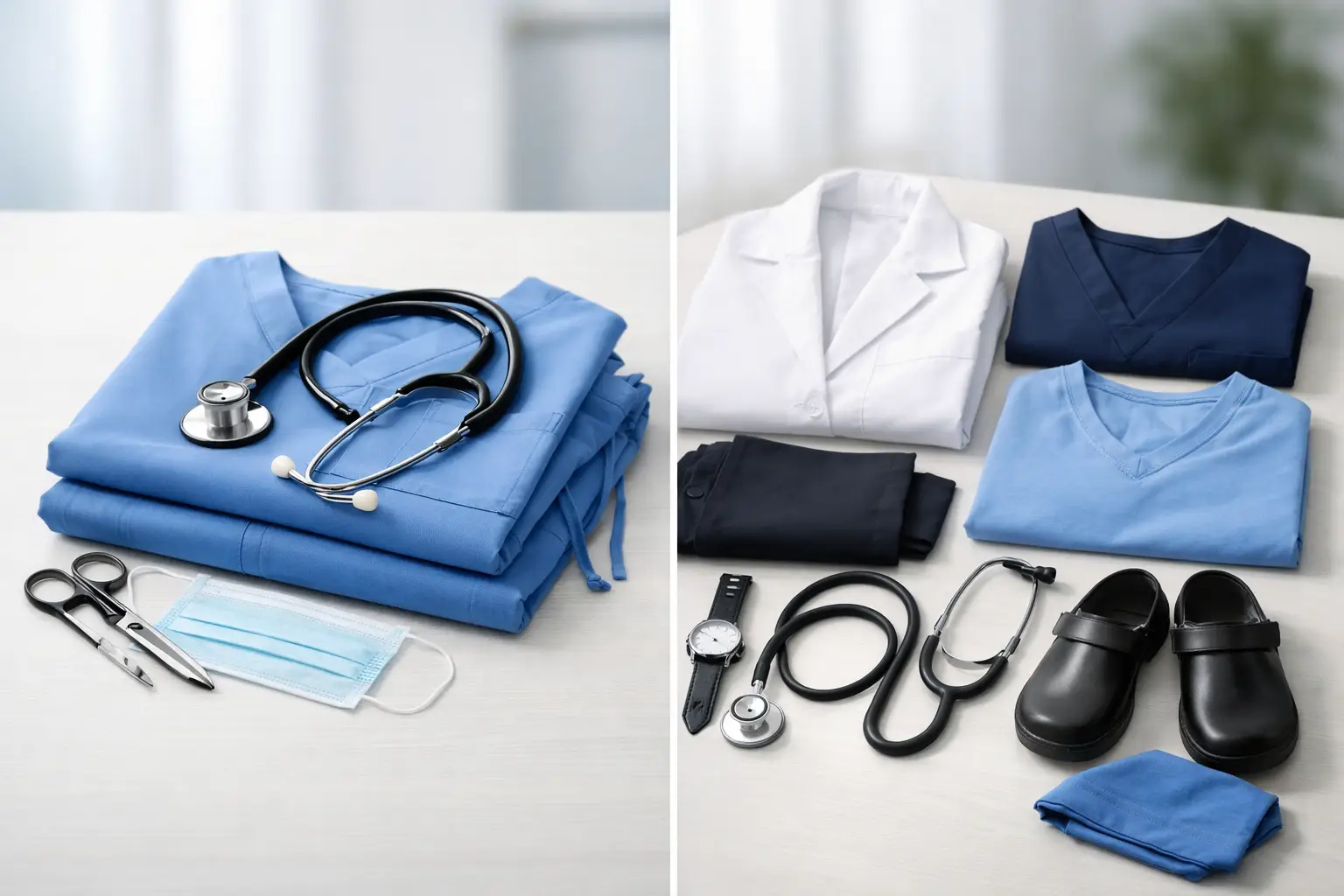
The morning before a shift rarely leaves room for fashion dilemmas. Your outfit has to be ready, comfortable and predictable. That is why the question of whether to choose a medical set or separate pieces is not only about style. It is a real purchasing decision that affects comfort at work, the way the team looks and how the clothing behaves after many washes.
In practice, there is no single answer for everyone. For some people, a ready-made set will be the best choice, while others will prefer a separately selected medical top and trousers. It is worth looking at this choice through the lens of everyday work, the type of facility and your own preferences regarding fit.
Medical set or separate pieces: what does it depend on?
Most of all, it depends on what you expect from your clothing during a shift. If what matters most is a quick, simple purchase and a coherent look, a medical set usually wins. If the most important thing is a very specific fit for the top and the bottom, separate pieces have the advantage.
The nature of the work matters as well. Staff who work on the move, bend often, lift patients or spend many hours on their feet usually notice differences in trouser cut, rise height or leg width more quickly. In surgeries, medical receptions and facilities that focus on a uniform image, visual consistency of the whole outfit more often becomes the priority.
The way you buy also matters. For orders for whole teams, a set is simply easier from an organisational point of view. For an individual purchase, building a wardrobe from separate pieces may make more sense.
When a medical set is the best choice
A ready-made set has one big advantage: it eliminates most of the decisions. You get an outfit designed as a whole, with matching colours, fabric and line of the cut. That saves time and reduces the risk that the top and the bottom will look good separately but worse together.
For many people, it is also the safer aesthetic choice. A set looks coherent and professional, which matters in contact with patients. A neat, uniform outfit organises the overall image and makes the staff look confident and consistent.
Advantages of a ready-made set in everyday work
A medical set works well when you value simplicity. You do not have to wonder whether the navy shade of the trousers is exactly the same as in the top, whether the fabrics fall in a similar way and whether the whole outfit will still look even after washing.
It is also a practical solution for frequent use. If both elements are made from the same fabric, they usually react similarly to washing, drying and intensive wear. That makes it easier to keep the outfit looking uniform for longer.
A set is also convenient for people who want to complete their professional wardrobe quickly. One purchase solves the issue of a full work outfit, without having to compare cuts, pockets or leg lengths separately.
Who a set works especially well for
It is a very good solution for people starting work, putting together their first professional wardrobe or wanting to limit the time spent choosing. It also works well in facilities that require the team to dress consistently.
In a B2B model, a set is often simply the most efficient option. It makes ordering for a larger group easier, simplifies colour control and speeds up the purchasing process. If predictability and a uniform standard matter, ready-made sets clearly have the advantage.
When it is better to choose separate pieces
Buying a medical top and trousers separately gives you more control. That matters especially when your body shape does not fit perfectly into a standard size set. In practice, many people wear one size on top and another on the bottom. In that case, a set can mean a compromise, and after 10 or 12 hours of work, a compromise may simply become uncomfortable.
Separate pieces also give you more freedom to build your own functional outfit. You can choose trousers with a higher rise, more pockets or a more flexible waist, and pair them with a top that has a different sleeve or neckline cut. That is particularly important for people who know exactly what they need from their outfit on a shift.
Better matching to body shape and work style
The biggest advantage of separate pieces is precise fit. If you need a more shaped top but looser trousers, a set will not always provide that. The same applies if you want a shorter top, joggers instead of classic trousers or a specific pocket layout.
In many medical professions, details really make a difference. A paramedic, a nurse, a procedural doctor and a laboratory worker do not move in the same way. Someone who spends almost all day with documentation works differently from someone who is on the move for most of the shift. The possibility of choosing each element separately makes it easier to adapt the clothing to those realities.
Easier replacement and expansion of the wardrobe
Separate pieces also win when you think long term. Trousers usually wear out differently from tops. If you buy them separately, it is easier to replace only the piece that actually needs refreshing.
It is also a cost-effective solution if you want a few work outfits from a limited number of garments. Two tops and two bottoms in the same colour family can give you more practical combinations than two rigidly defined sets.
Medical set or separate pieces and comfort
Comfort does not depend solely on whether you choose a set or separate parts. The key factors are the cut, the type of fabric, the stretch of the material, the pocket layout and the way the clothing works with your body. The mere fact that something is a set does not guarantee comfort. Likewise, buying separate pieces does not automatically mean a better fit.
It is worth paying attention to three things. First, whether the top and bottom can be worn comfortably for many hours without pulling, pressure or excess fabric. Second, whether the outfit keeps its shape after washing. Third, whether the pocket layout and the cut suit what you actually do at work.
If the clothing is meant to be genuinely functional, comfort should always win over habit in the way you buy.
What works better when buying for a team
When dressing an entire facility or practice, the question of whether to choose a medical set or separate pieces takes on extra meaning. Here, it is not only one person's comfort that matters, but also logistics. The order has to be repeatable, clear and easy to roll out for a larger group.
In such situations, a set usually simplifies the process. It is easier to keep the team's look consistent, control colours and shorten the time needed to choose. That matters where workwear is meant to support the professional image of the facility and make staff identification clearer.
At the same time, not every group will function well in one predetermined model. If the team is varied in body shape or in the specifics of their duties, it may be more practical to agree on a shared colour palette and allow different top and bottom cuts. That is a compromise between consistency and the real comfort of the staff.
How to make a good buying decision
The easiest way is to start with your own work routine. If you value a quick choice, want to avoid mixing cuts and need a uniform ready-made solution, a medical set will be a safe choice. If you have clearly defined needs regarding the cut or you wear different sizes on top and bottom, it is better to choose separate pieces.
When buying, it is worth checking the size chart, the fabric description and the practical details. Pockets, rise height, neckline type or waistband stretch often decide whether the clothing will stay comfortable through the whole shift. These are small features, but they are usually what separates clothing that only looks good from clothing that truly works with you.
It is also good practice to think about the purchase not only for today, but for the months ahead. If you need a coherent outfit right away, a set makes sense. If you build the wardrobe step by step and want to replace individual pieces easily, separate elements will give you more flexibility. In the offer of brands focused on premium-practical medical clothing, such as EXP Odzież Medyczna, both approaches can work well as long as the choice comes from real work needs.
The best medical clothing is not the one that looks good in a photo, but the one you stop thinking about after an hour at work. If you use that as your main criterion, it becomes much easier to choose a solution that will work every day.