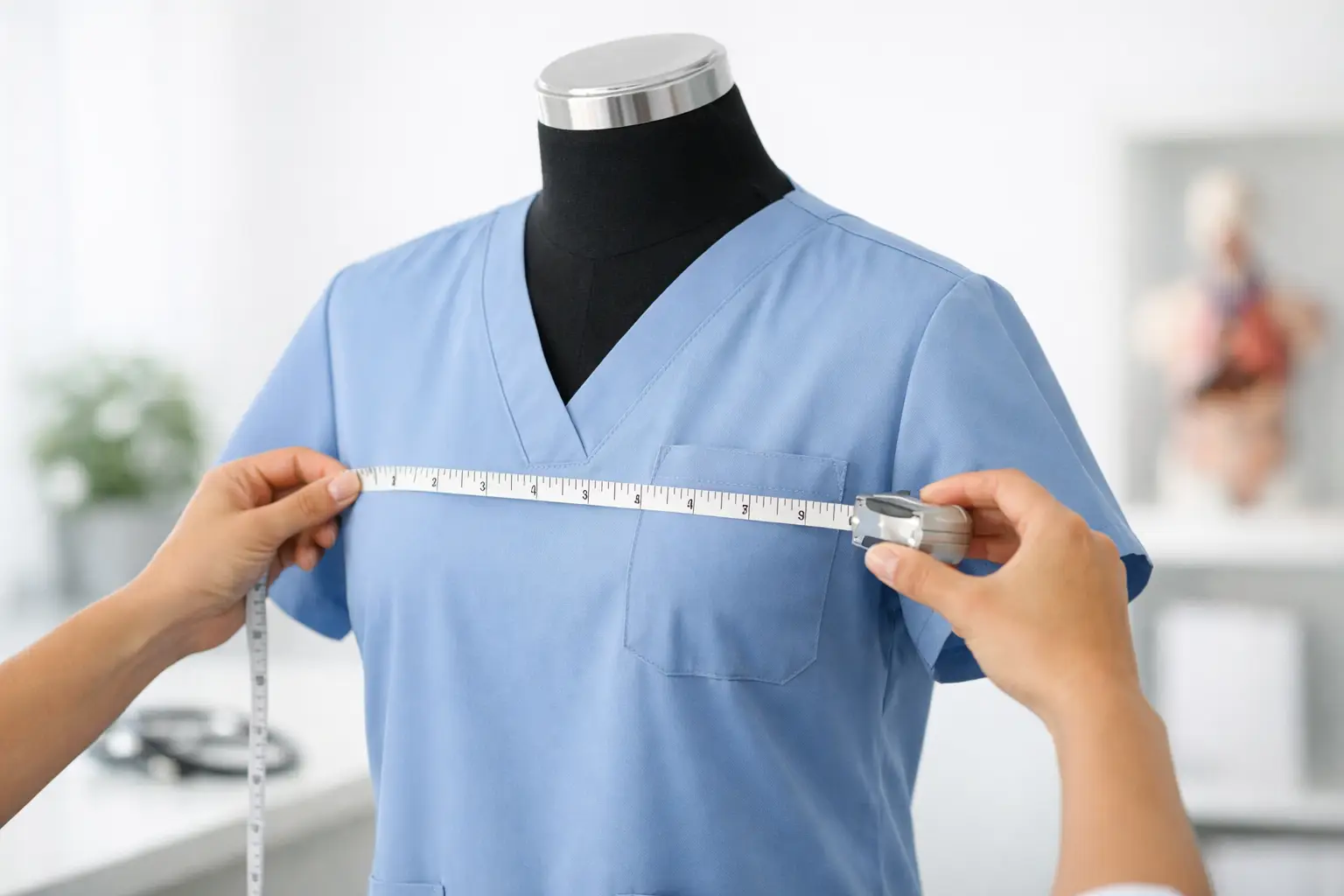
A poorly fitting medical blouse quickly makes its presence felt – it drags on the shoulders, restricts movement when bending, or becomes too loose after a few hours on duty. Therefore, the question of how to measure a medical blouse correctly is not a trivial matter, but a practical step in the purchasing process. A well-taken measurement helps you choose a size that will be comfortable for work, not just look good in the product photo.
How to measure a medical blouse correctly before purchasing
First, it's worth establishing one thing: you can measure your body or just a blouse you already wear and that fits well. In practice, the best results are achieved by combining both methods. Measuring your body provides a starting point, while measuring a tried-and-true blouse allows you to relate the numbers to actual comfort during work.
To measure, all you need is a soft tape measure, a piece of paper or your phone to record your results, and a few minutes of peace. Measure yourself in light clothing or underwear, standing comfortably, without sucking in your stomach or tensing your shoulders. If you're measuring after a long shift, remember that your body may be more swollen than in the morning – this can be significant with tight-fitting clothing.
Medical clothing isn't just about aesthetics. A blouse must allow for ease of use when lifting arms, reaching into cabinets, working with patients, or sitting for long hours. Therefore, a size that's too tight usually performs worse than a model with minimal room. On the other hand, a blouse that's too loose can be distracting, stick out, and look less professional.
Measuring chest circumference
This is the most important measurement when choosing a medical blouse. The tape measure is placed horizontally across the fullest part of the chest, usually at bust level, ensuring it doesn't fall down the back or become too tight. The tape measure should be snug but not constricting.
If you're choosing a more fitted women's style, the bust measurement is particularly important. For straight or unisex styles, it's still crucial, but the hip width and overall length of the piece may also play a more significant role. If you're between two sizes, the decision depends on the cut and whether you prefer a blouse that fits closer to the body or one with more room for work.
Waist and hip circumference also matter
Many people focus solely on the bust or chest, only to discover that the top is tight on the hips or rides up during movement. The waist is measured at the narrowest point of the torso, and the hips at their widest. In longer medical tops, this latter measurement can be crucial.
If a model has a fitted waist, side slits, or a straight tunic cut, the way it fits on the body may vary significantly. Therefore, when comparing with the size chart, it's best not to ignore any of the basic measurements. Comfort at work often depends on a few centimeters at the bottom of the blouse.
Shoulder width and blouse length
It's worth checking your shoulders, especially if you experience tension when lifting your arms or if the seams fall too close to your neck. In practice, many people don't measure shoulder width separately, but compare this measurement on their favorite blouse. This is often simpler and more accurate.
Measure the length of your blouse from the highest point of your shoulder to the hem. There's no single ideal measurement. Shorter styles offer a lighter look and greater ease when sitting, but not everyone feels comfortable in them. Longer styles provide better coverage, although they may be less comfortable for some body types or those with very dynamic work. This depends on your preferences and the nature of your job.
How to measure a medical blouse correctly on the finished product
If you have a blouse that works well, lay it flat and measure the garment, not your body. This is a very practical method when shopping online, as it allows you to compare the actual proportions of the cut. Just remember to make sure the garment fits evenly, without stretching the material.
Measure the width under the arms from seam to seam. Then check the width at the waist and bottom of the blouse, the total length, and the sleeve length if you're choosing a model with sleeves. When the manufacturer provides measurements of the garment taken flat, comparisons are easy. When the table refers to body measurements, be careful not to compare these measurements directly.
The most common mistake is for customers to try on a loose blouse and expect the same result from a fitted model. However, the fit makes a huge difference. A fitted blouse and a straight-cut scrub in the same size can feel completely different when worn.
The most common mistakes when measuring a medical blouse
Most mistakes result not from the chart itself, but from rushing. Taking the tape measure at an angle, measuring over thick clothing, or choosing a "just right" size are classic problems. This is even more important in medical clothing than in a regular T-shirt, as the garment will be worn with you for many hours.
Another common mistake is ignoring the fabric composition. If the fabric is stretchy, a fitted style can still be comfortable. If the material has little stretch, it's worth leaving more room. Similarly, with the cut, a slim-fit model won't fit like a classic cut, even if the label size is the same.
It's also worth being careful about assuming you always wear one size regardless of the manufacturer. In practice, sizing can vary, so it's best to always check the chart and compare it to your current measurements. This is especially important when purchasing a team kit, where sizing errors quickly multiply with larger quantities.
What to do if you're between sizes
This is one of the most common situations. If your measurements fall between two sizes, first consider the blouse's cut and material. For a fitted cut, fabric without much stretch, or work requiring intense movement, it's usually safer to choose the larger size. For a straight cut and fabric with added stretch, the smaller size may still fit properly.
What you wear under your shirt also matters. If you wear a tank top, thermal shirt, or an extra layer underneath, consider this when measuring. Comfort doesn't end with just buttoning or slipping the shirt over your head. What matters is how the clothing performs after several hours of wear.
When it comes to staff orders, it's worth standardizing the way everyone is measured. A single reference point, the same method, and the same results recording reduce the risk of errors. This saves time for facilities, and increases the chance for consistent and accurate matching for the team.
How fit affects comfort at work
A well-fitting medical blouse shouldn't distract attention. It shouldn't restrict your shoulders when examining a patient, constrict your chest when bending over, or ride up with every movement. That's why size numbers alone aren't enough—specific measurements and the actual cut are what matter.
In practice, the best styles are those that offer a little extra room where the body works hardest – in the shoulders, underarms, and hips. This doesn't mean the blouse has to be baggy. Rather, it's about striking a balance between a neat appearance and freedom of movement. This is especially important in professions where clothing is worn all day and washed frequently.
If you want a predictable choice, it's worth comparing not only the size itself, but also the style description and construction of the model. In practice, it's the combination of measurement and knowledge of your own preferences that yields the best results.At EXP Odzież Medyczna, this approach works particularly well when selecting clothing for intensive shift work, where fit has a direct impact on everyday comfort.
Ultimately, there's a simple rule: measure calmly, write down the results, and don't guess. A few minutes spent on accurate measurement usually saves much more time than having to replace the wrong size later.