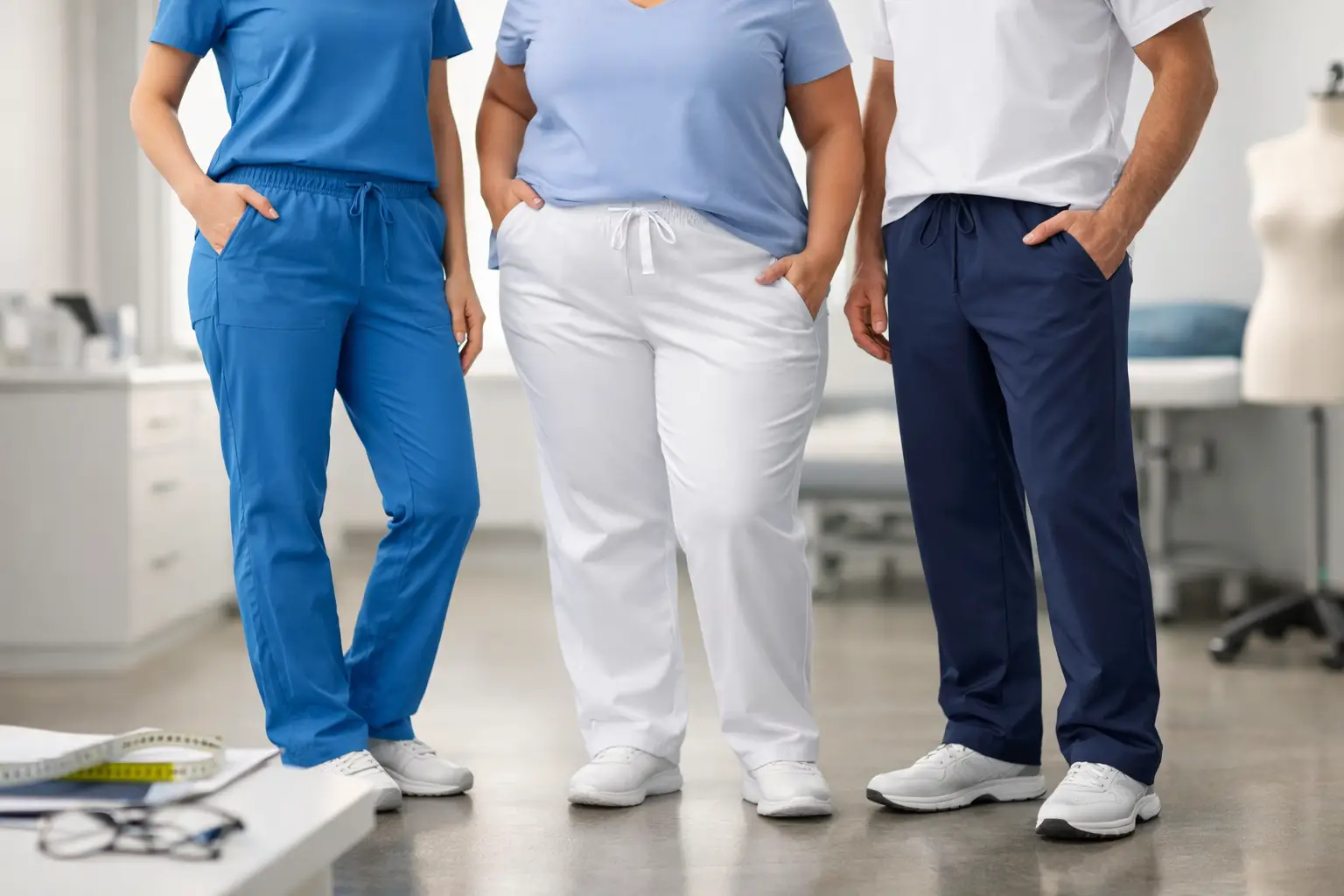
Well-fitting medical trousers are noticeable throughout your shift—but in a good way. They don't slip down when you bend down, don't tighten your thighs when you walk quickly, and don't require adjusting every hour. If you're wondering how to choose medical trousers for your body, it's worth starting not with the size itself, but with your body proportions, the nature of your work, and how the material behaves during movement.
Medical clothing is about more than aesthetics. The cut must work with the body during long hours of wear, with frequent sitting, bending, and reaching. Therefore, trousers that look good on the hanger won't always perform well during a shift. The best choice is one that simultaneously streamlines the silhouette, provides freedom of movement, and retains its shape after washing.
How to choose medical trousers for your body type and work routine
The first rule of thumb is simple: don't choose a style based solely on what you wear outside of work. Medical trousers perform differently than jeans or suit trousers. Here, the elasticity of the fabric, the rise, the waistband, and the width of the leg all play a role.
If you're constantly on the move, transporting patients, frequently crouching, or performing procedures that require a full range of motion, you need a model that leaves room in the hips and thighs. On the other hand, for office or laboratory work, more structured cuts with a straighter leg line are more appropriate. The point isn't to make the pants loose or too fitted. The point is to ensure they're well-fitted and the fabric doesn't work against you.
The most important elements of the cut
When choosing, it's worth considering three things at once: the waist, the inseam, and the hip line. These are the elements that most influence whether the pants will slim you, balance your proportions, and remain comfortable for hours.
Height of the state
The rise of trousers is more important than often assumed. A low rise can be problematic in medical work, as it can reduce comfort when bending over and require constant readjustment. A high or mid-rise waist usually provides better support and creates a neater look.
For those with a fuller stomach or more pronounced hips, a mid-rise or high-rise waistband is preferable, as it flatters the waist and doesn't dig in when sitting. For slimmer figures, a high waistband can further elongate the legs, but it's important to avoid pants that are too tight around the waist. Comfort during long shifts is more important than a tight fit.
Leg width
Straight leg trousers are the most versatile choice. They look good on many body types, don't visually shorten the legs, and pair easily with various styles of medical tops. They're a safe option for those who want to avoid mistakes when making their first purchase.
Tapered legs are perfect when you're looking for a more modern, streamlined look. They look great on proportionate figures and on those who want to visually slim their lower legs. However, be careful not to make the cut too narrow in the calves and thighs—otherwise, comfort quickly deteriorates.
Wider legs offer more freedom of movement and often better balance a figure with larger thighs or hips. They can also work well for an inverted triangle body type when you want to add volume to your lower body.
Belt and adjustment method
An elastic waistband enhances comfort, especially when working shifts and frequently changing positions. Drawstrings or a drawstring allow for a more precise fit, which is important for figures between sizes. If you have a narrower waist and wider hips, the chart size alone may not be enough – then the waist adjustment becomes a real convenience.
How to choose medical trousers for your body type
There's no one-size-fits-all style. However, there are styles that work better with specific proportions.
Hourglass silhouette
If you have a defined waist and proportionate hips, it's worth choosing trousers that don't disrupt these proportions. Mid-rise or high-rise styles with straight or slightly tapered legs work well. A cut that's too loose can take away from your figure, while one that's too tight will be less practical for work.
Pear silhouette
If your hips are wider than your shoulders, straight-leg trousers with a smooth finish around the hips work well. It's best to avoid excessive side pockets at thigh height, as they can further widen this area. A material that stretches easily and doesn't tighten with every movement also helps.
Apple silhouette
For larger volumes around the midsection, it's worth looking for styles with a firm waistband, a mid- or high-rise waist, and a straight leg. It's best if the pants drape softly around the waist, but aren't too thin. Fabric that's too delicate can emphasize areas you'd rather have well-protected and comfortable at work.
Rectangular silhouette
If your waist, hips, and shoulders are similar in proportion, you can afford more styles. Trousers with slightly tapered legs or cargo pants work well, as long as they don't detract from the overall lightness of your silhouette. However, it's worth being wary of very wide cuts, which can look heavy and detract from the overall professional feel.
Inverted triangle silhouette
Broader shoulders and narrower hips are best suited to styles that add visual balance to the lower body. These can include trousers with straight or slightly wider legs, and sometimes even models with pockets, provided they are functionally placed and don't overdo the bulk.
The material is as important as the cut
Even the best design won't do its job if the fabric is too stiff or too thin. Materials that combine durability with a touch of flexibility work well in medical work. This is important not only for comfort but also for how the pants fit the body after several hours of wear.
Fabric with a touch of stretch typically adapts better to movement and pulls less at seams in critical areas. On the other hand, a completely stiff fabric may initially look neat, but with intense activity, it will quickly reveal any inconsistencies in the cut. Too thin a fabric isn't always a good thing either – it can be breathable, but it may not fit well around the hips, thighs, and knees.
In practice, it's worth finding a compromise. Pants should be lightweight but not limp. Stretchy but not lose their shape. This balance determines whether a piece will perform well after the first wash and after another week of wear.
The most common mistakes when choosing medical trousers
The most common mistake is buying a size too small, thinking the material will stretch. This is usually a bad idea when it comes to workwear. This can restrict movement, cause the pants to wear out at the seams more quickly, and look worse after a few washes.
The second mistake is choosing a cut that's too loose, thinking it'll be the most comfortable. Excessive fabric can be more of a nuisance than a moderate fit, especially if the legs twist, catch, or don't fit properly under a sweatshirt. Comfort comes from a good cut, not just width.
The third problem is neglecting the leg length. Even a well-fitting waist and hip area won't be enough if the pants are too long or end in an inconvenient place. This affects both appearance and safety.
What to pay attention to before buying
Before choosing, it's worth comparing your measurements with the size chart and checking whether the model is described as slim, regular, or relaxed fit. These markings really make a difference. It's also worth assessing what type of pockets you need for everyday work – sometimes a practical solution improves comfort more than the style itself.
If you're buying trousers for an entire team, don't assume that one style will work for everyone. A consistent look across your team is important, but it shouldn't mean the same cut for every body type. In practice, collections that allow you to choose from a variety of styles in the same color scheme and similar fabric quality work better. This is a comfortable and more professional solution.
At EXP Odzież Medyczna, it is clear that this approach to choosing makes sense - what matters is not only appearance, but also how the clothing works with the user throughout the day.
Well-fitting medical trousers aren't meant to distract attention. They're meant to simply function: maintain your form, support your movement, and ensure you look professional and feel comfortable no matter the pace of your shift.