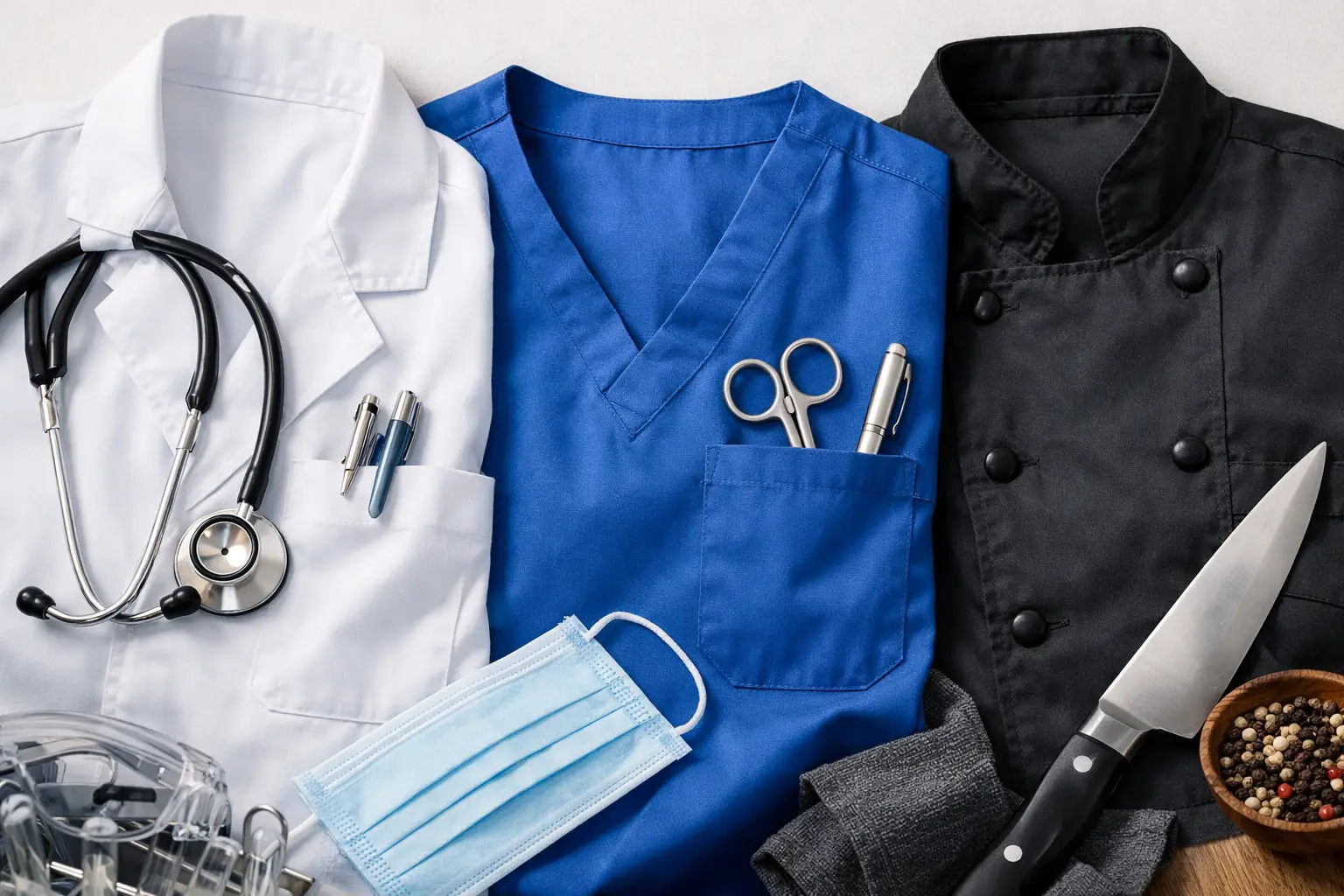
Putting on a lab coat for the first time usually quickly proves the point. What looks good in a photo doesn't always translate well to rounds, desk work, collecting materials, or long shifts. If you're wondering how to match a lab coat to your specialty, it's worth starting not with color or style alone, but with your actual work routine.
How to match your lab coat to your specialization in practice
A medical gown isn't universally applicable to every profession. A doctor working primarily in an office setting has different needs, a laboratory diagnostician has different needs, and a surgical technician or pharmacist has different needs. The differences primarily concern length, number of pockets, cut, fastening method, and the material's resistance to everyday wear.
In practice, a good choice should combine four key elements: comfort for hours, freedom of movement, aesthetics appropriate for the workplace, and durability after frequent washing. If even one of these elements fails, the apron becomes a hindrance rather than a support.
First the scope of duties, then the style
The most common mistake is choosing a gown based solely on appearance. However, someone who spends most of their day seeing patients at a desk and moving between offices may need a different model than someone who is constantly on the move, bending, reaching for accessories, and performing tasks that require a high degree of mobility.
Therefore, before purchasing, it's worth answering a few simple questions: Will the apron be worn throughout the entire shift? Do you need spacious pockets? Does the job require frequent sitting, bending, and lifting of arms? Does the facility have specific image standards? These answers will narrow down the selection more effectively than the product category name alone.
Apron for doctors, nurses and office staff
In professions where patient contact and professional presentation are paramount, a lab coat should look neat but not restrict movement. Physicians, especially in clinics and private practices, often choose classic models – straight cut, with an aesthetic collar or neckline, and a length that provides a formal appearance.
Aprons with pockets for small accessories, a notebook, or a phone are a good choice here. Too few pockets can be a problem, but too many aren't always an advantage either, as they can weigh down the figure and reduce comfort. If an apron is intended to convey a professional image, it should fit well even after several hours of work, not just immediately after putting it on.
For nurses and office staff, the needs can be more diverse. If the gown is worn interchangeably with medical kit or scrubs, lightweight material and ease of donning become important. When the job requires frequent movement, administering equipment, and patient contact, less rigid styles with carefully planned shoulder and sleeve widths are more appropriate.
Length matters
A short apron may be more comfortable for intense movement and a faster work pace. A longer one often looks more formal and better fits the character of a doctor's office or medical/administrative office. There's no single rule here. However, if the apron rides up when you sit down, strains at the hips, or interferes with climbing stairs, it's a sign that the length hasn't been chosen correctly.
How to choose a lab coat and diagnostics gown
In the laboratory, priorities are usually different than in the office. Here, functionality, ease of maintenance, and solutions that don't hinder work at the workstation are paramount. A lab coat should provide comfort while standing, sitting, and performing precise movements, while also maintaining its aesthetic appearance despite frequent washing.
For diagnosticians and laboratory staff, the fastening method is also practical. Too-small buttons or awkward snaps can slow down changing and daily work organization. It's also worth paying attention to the sleeves – their cut shouldn't interfere with manual work or catch on station equipment.
Materials that are resistant to deformation and discoloration are particularly effective in this specialization. A lab coat is subjected to intense wear and tear, so even a well-tailored model will fail if it loses its shape after several washes.
Apron in dentistry, cosmetology and aesthetic medicine
In specialties where both hygiene and a very tidy appearance are essential, the choice of gown can be more stylistically conscious. It's not about fashion for fashion's sake, but rather about the patient's attention to detail. A neat, modern design enhances the sense of professionalism.
In dentistry or aesthetic medicine, styles that are fitted, but not tight, work well. This is an important distinction. The gown should enhance a professional appearance, not hinder work at the chair, equipment, or during procedures. If the cut is too narrow at the shoulders or waist, it quickly begins to restrict movement.
In these areas, color and team cohesion are often crucial. When purchasing for the entire staff, it's worth considering not just a single item, but whether a given clothing line will maintain a uniform look for the facility and allow for convenient sizing for a variety of body types.
Material that works with you
Even the best-designed apron won't work if the fabric is too stiff, too thin, or too insensitive. When choosing, it's important to consider the material's composition and behavior after washing, not just the appearance of the new product.
In everyday medical work, it's crucial that the gown is breathable, allows for easy movement, and maintains its shape despite frequent use. The material should be comfortable to wear for many hours, but also durable enough. Too light a fabric may appear comfortable but wear out more quickly. On the other hand, very thick material can be durable but less practical for long shifts.
This is where compromise often comes into play. If you work in cooler spaces and want a more formal look, a slightly more structured apron might be a good choice. However, if mobility and work pace are priorities, lighter, more flexible options are usually better.
Size and fit - no guesswork
The wrong size can ruin even a perfectly good model. An apron that's too small will drag on your shoulders, come apart at the fastening, and restrict your movement. One that's too large will look sloppy and can also be distracting while you're working.
Therefore, it's best to base your size selection on the chart and your actual measurements, rather than relying on specific sizing from other brands. Cut differences are significant in medical clothing. The same size may fit differently in a fitted cut than in a straight cut.
If the apron is to be worn over a blouse or scrubs, you need to consider the layer underneath. It's a detail that often determines comfort. At EXP Odzież Medyczna, this stage is particularly important because well-chosen clothing should simply work from the first day at work and not require adjustments after the order is received.
What to look for when trying on or choosing online
It's best to check whether the apron allows you to comfortably lift your arms, bend down, and sit down. It's also worth assessing how it fits your back and hips, and whether the pockets are at a comfortable height. The apron shouldn't just fit when standing. It should be comfortable when moving, as that's when it works alongside the user.
Purchasing for a team - different criteria than for individual purchases
When clothing is selected for several or a dozen people, the importance of consistent designs, size availability, and visual consistency increases. In this case, it's not enough that the apron looks good on one person. It must work well on a variety of body types and maintain a consistent standard across the entire team.
Facilities, offices, and laboratories often choose models that combine ease of selection, durability, and aesthetics. This is a sensible approach, as with larger orders, not only appearance matters but also predictability. It's beneficial when you can easily order a missing size or restock clothing for a new employee without changing the entire clothing line.
When to choose an apron and when it is better to choose another type of clothing
Not every specialty requires a lab coat as a basic uniform. Sometimes scrubs or a medical uniform are a more practical solution, with the coat acting as an additional layer in specific situations. This is especially common where work requires maximum mobility and lightweight clothing throughout the shift.
However, if a lab coat is standard at the workplace, it shouldn't be treated as a second-choice accessory. A well-chosen model impacts work comfort, the way staff perceive patients, and everyday convenience. This is immediately noticeable – during movement, after several washes, and at the end of a long day, when the clothing should continue to be helpful, not tiring.